CURRENT PRODUCT
One decision-intelligence platform. Four governed ways to examine enterprise reality.
ABEIF can start broad with Enterprise Assessment, focused with one material claim, system-led through governed connected signals, or process-led through a bounded Process Intelligence scan. All four paths preserve scope, lineage, contradiction, governed evidence semantics, decisions and execution without creating parallel intelligence engines.
UNDERSTAND THE ENTERPRISE
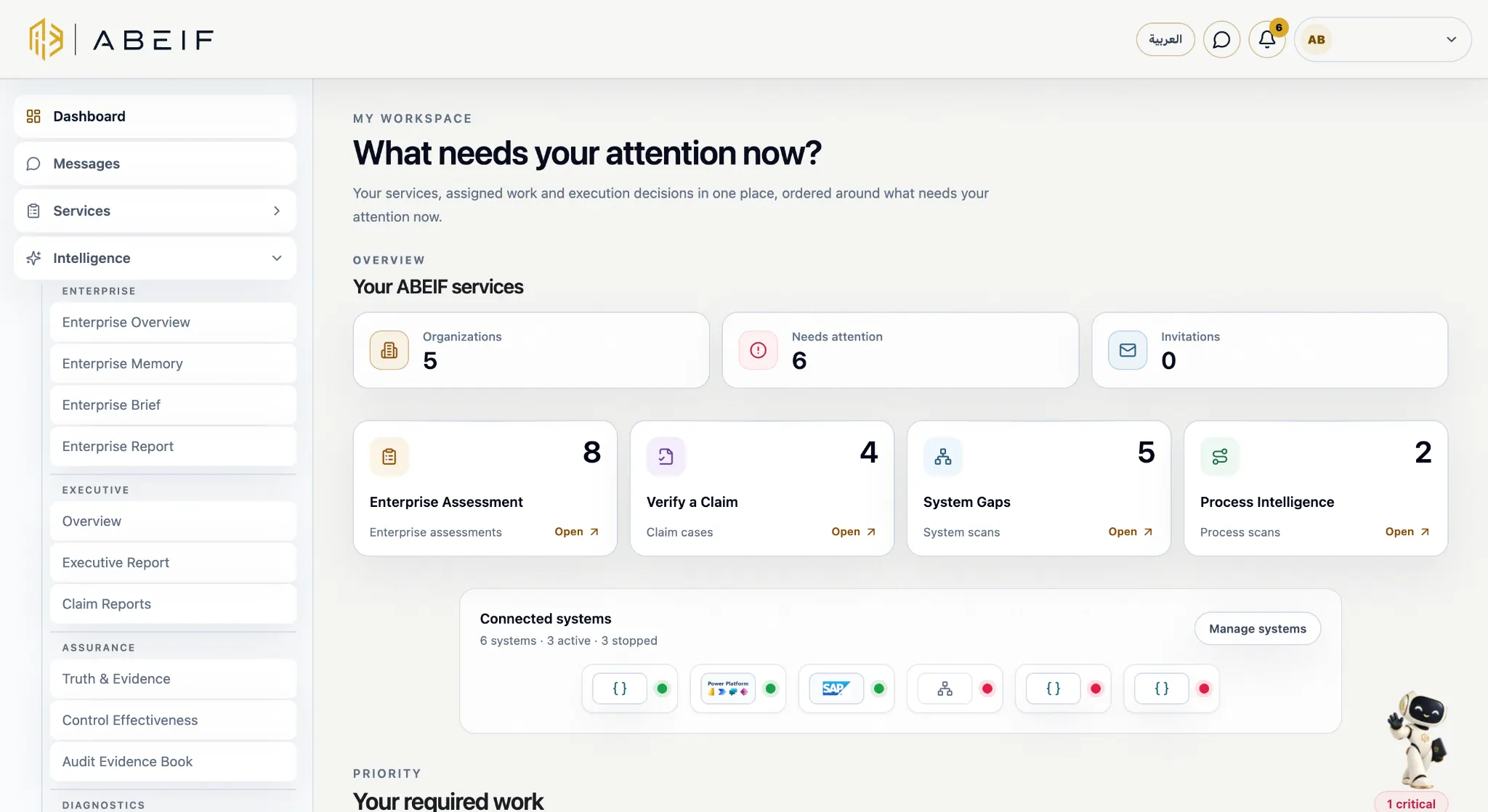
Enterprise Assessment
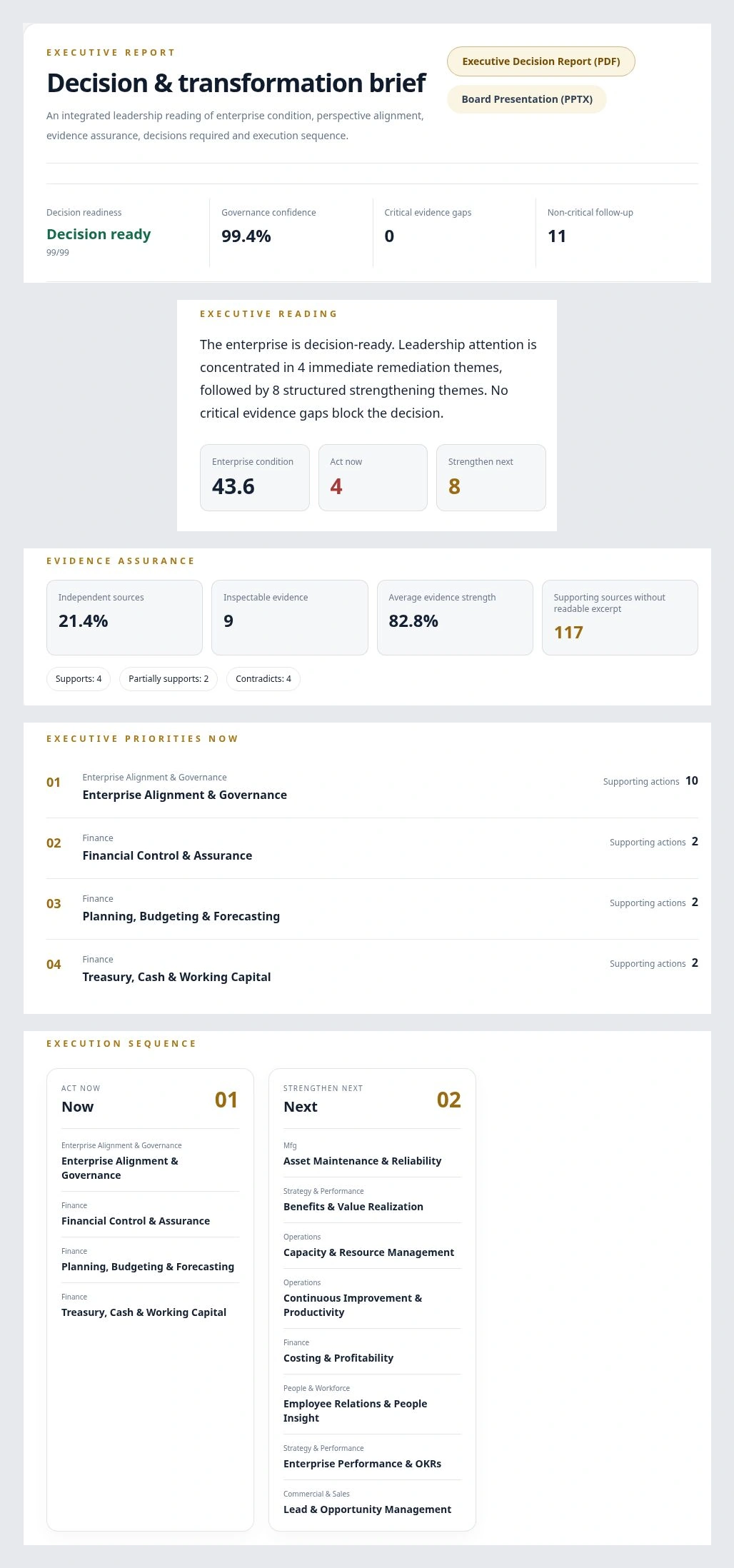
Build a governed cross-functional view of capabilities, processes, controls, risks, evidence and organizational alignment. Adaptive acquisition follows business knowledge and material uncertainty rather than a fixed questionnaire.
Use it when leadership needs to understand where the organization stands, why functions see reality differently, and what must be addressed next.
GOVERNED ASSURANCE
Verify a Claim
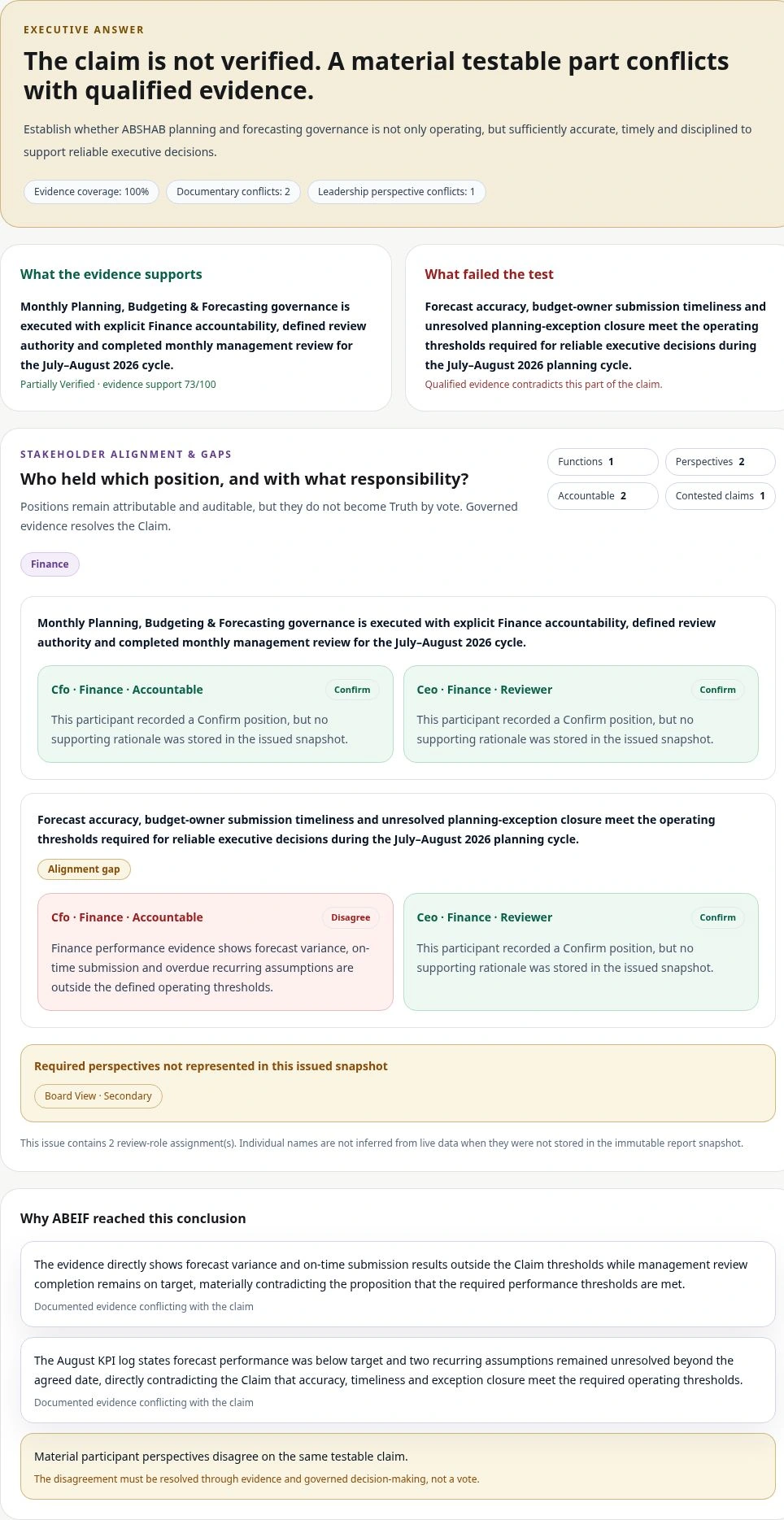
Frame a specific material proposition, define its scope and acceptance conditions, collect responsible and independent perspectives, test documentary Evidence, expose contradiction and produce a governed Assurance outcome.
Use it when management needs to know whether a delivery, control, process, system, project or acceptance statement can actually be supported.
UNDERSTAND THE SYSTEM REALITY
System Gaps Assessment
Use governed Connected Systems and observations to identify gaps across applications, processes and controls, including cross-system flow, reconciliation, latency, exceptions and Designed vs Configured vs Actual behavior. System observations remain subject to governed scope, source lineage and existing Truth qualification.
Use it when leadership needs to understand where operational reality diverges across systems, processes, controls or expected design.
UNDERSTAND HOW THE PROCESS ACTUALLY RUNS
Process Intelligence
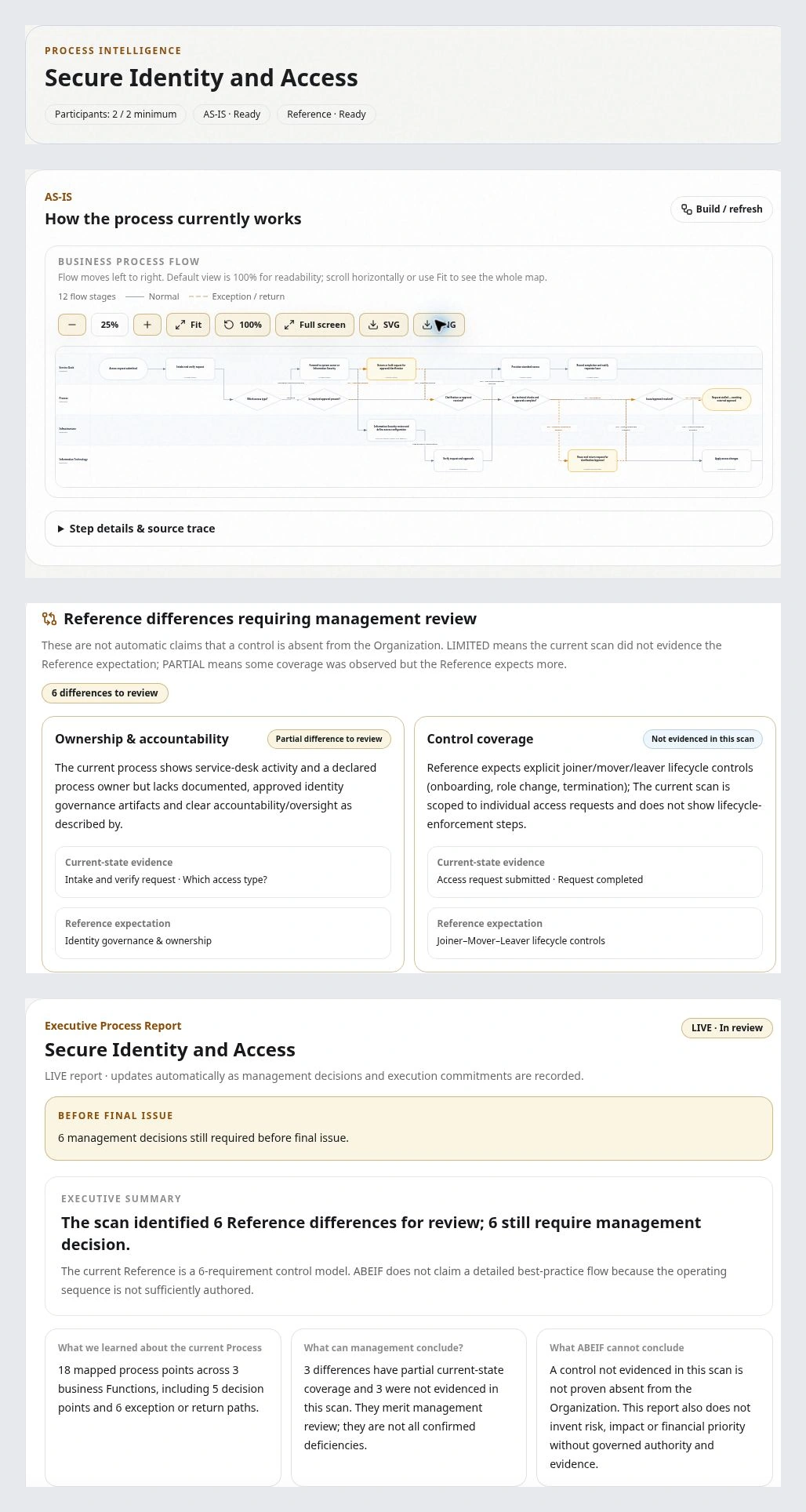
Scan one bounded business process through the people who perform it, attributable Participant Context, Documentary Evidence and eligible connected observations. Reconstruct the AS-IS flow, preserve normal and exception paths, compare it with governed Business Knowledge, and expose source-backed process differences.
Use it when management needs to see who does what, where informal workarounds or contradictory process versions exist, and which supported gaps require an explicit management decision.
Four starting points. One governed intelligence system.
CONNECTED INTELLIGENCE
People, Evidence and systems belong in the same decision reality.
ABEIF brings governed system observations alongside human perspectives and documentary Evidence, then connects them to the same Knowledge, Truth, Decision, Execution and Enterprise Memory foundations.
PeopleEvidenceConnected Systems
Governed Intelligence → Truth → Decisions → Execution
Native connection paths currently include
D365 Finance & OperationsDataverseSAP S/4HANAOracle FusionOdooSalesforceREST
Connections are consented, scoped and read-governed. System access does not become unrestricted data authority, and observations do not become Truth without the existing qualification path.
01
Understand the enterprise
Use adaptive, capability-led intelligence across business and technology functions instead of forcing every organization through one fixed questionnaire.
02
Capture what people actually mean
Preserve the answer, the participant context behind it and attributable semantic observations so a score is never the whole story.
03
Reveal alignment and disagreement
Compare relevant perspectives, preserve contradiction and expose perception or coordination gaps instead of averaging disagreement away.
04
Qualify what can be trusted
Keep participant assertion separate from documentary Evidence, then expose confidence, lineage, uncertainty and fail-closed Truth qualification.
05
Explain why management must decide
Show what shaped a finding or Assurance outcome, why it belongs on the management agenda, what is proven, what remains uncertain and which decision is required.
06
Move direction into accountable execution
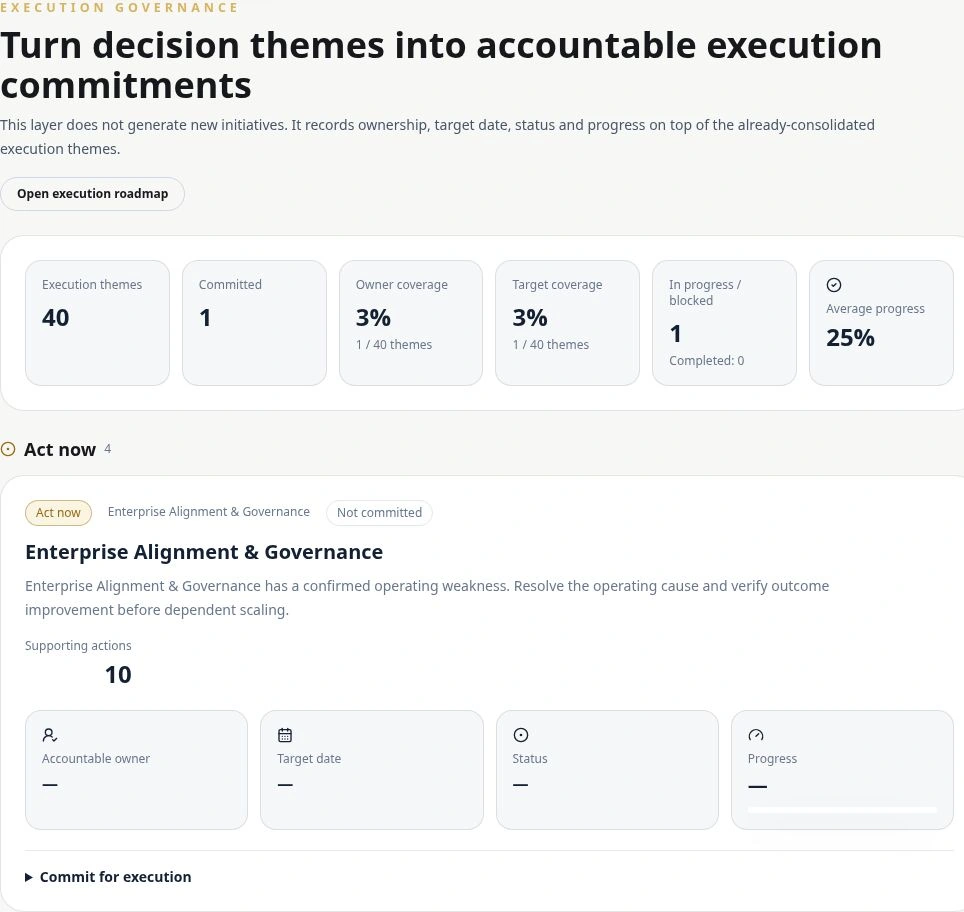
Connect recommendations and decisions to initiatives, owners, targets, dependencies, commitments, Impact Simulation, progress and closure proof without changing real execution state from the sandbox.